
Close
Close
The Lion Group believes that enhancing the value of its human capital is essential for achieving sustainable growth and realizing Vision 2030 2nd STAGE, its current medium-term management plan.
We position the enhancement of human capital value as a key management priority and are committed to creating an environment grounded in “health and productivity management” that enables every individual to thrive and play an active role.
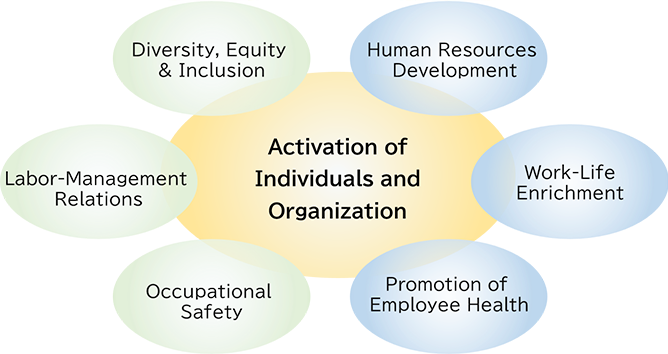
With the goal of enhancing human capital value, we strive to improve the dynamism of both our people and organization. To achieve this, we prioritize six priority areas: promoting diversity, equity & inclusion; promoting work-life enrichment; developing human resources; improving employee health; and enhancing the occupational management system while maintaining sound labor-management relations. Furthermore, we position health & productivity management as the common foundation for these six areas of focus, working specifically to deepen health management, transform healthy behaviors into habits, and improve health literacy.
Since its founding, Lion has pursued its purpose, “Make a difference in everyday lives by redesigning habits: ReDesign,” while steadily growing its business by promoting oral hygiene as well as cleanliness and hygiene habits that contribute to people’s mental and physical well-being.
As a company whose mission is to deliver mental and physical healthcare to people, we regard the health of our employees who carry out this mission as both an indispensable and vital foundation of our management and an important form of capital that drives corporate value creation.
Based on this principle, we established our Guidelines for Health in 2012, which recognize the health of our employees and their families as a key management issue and clearly state that each employee is responsible for managing their own health and making healthy behaviors a habit.
As a concrete initiative, we are promoting efforts to support employee health enhancement through our “GENKI” Action program. We have designated three key areas for focused investment—deepening health management, fostering habitual health behaviors, and improving health literacy—and are implementing related initiatives at each business site and organizational unit. We have also established concrete performance targets, including improved work engagement, reduced absenteeism, and the adoption of preventive dental care habits, as part of our ongoing efforts to foster healthy habits.
As the officer responsible for promoting health management, I am committed to advancing these initiatives and will strive to enhance organizational vitality through the health and well-being of our employees and their families.
Kengo Fukuda
Representative Director, Vice President and Executive Officer
Officer Responsible for Health Management Promotion
| Key Sustainability Initiatives | Objectives (2030) | Indicators (2030) | Progress (2025 Results) |
|---|---|---|---|
| Promoting Diversity, Equity, and Inclusion | Establish an organization that enables new value creation by appointing decisionmakers with diverse values, thinking, and attributes. |
|
|
| Promoting Work-Life Enrichment | Create an environment that helps employees fulfill their ambitions through synergy between work and private life. |
|
|
| Developing Human Resources | Strengthen employees’ problem-solving skills to ensure that each individual can contribute to the execution of our management strategy. |
|
|
| Improving Employee Health | Support mental and physical healthcare for employees to reinforce Group human resources and achieve sustainable corporate growth. |
|
|
| Enhancing the Occupational Safety Management System | Enhance systems to ensure compliance with occupational safety and health laws and regulations and to enforce safety awareness thoroughly for the safety and peace of mind of employees and outside partners working on site. |
|
|
* We are revising out targets and indicators for the four items related to human capital based on our 2025 results and moving forward with their implementation.
Sustainability Material Issues, 2030 Objectives and Indicators, 2025 Results and Measures to 2030(792KB)