
Close
Close
The Lion Group, in order to take responsibility for identifying, preventing, mitigating and addressing negative human rights impacts caused or contributed to by its business activities, established the Human Rights Review Committee, a cross-departmental organization that takes the lead in promoting human rights due diligence*through the following process based on the UN Guiding Principles on Business and Human Rights while also engaging in dialogue with stakeholders involved with the Group’s business, including employees and temporary employees, business partners, suppliers, communities, consumers, external experts and organizations related to human rights.
Recognizing that human rights risks may change as the Lion Group’s business activities, social conditions and the human rights environment evolve, we will seek better ways to enhance the effectiveness of our efforts by implementing a PDCA cycle for our Human Rights Due Diligence Process, which includes the Human Rights Impact Assessment.
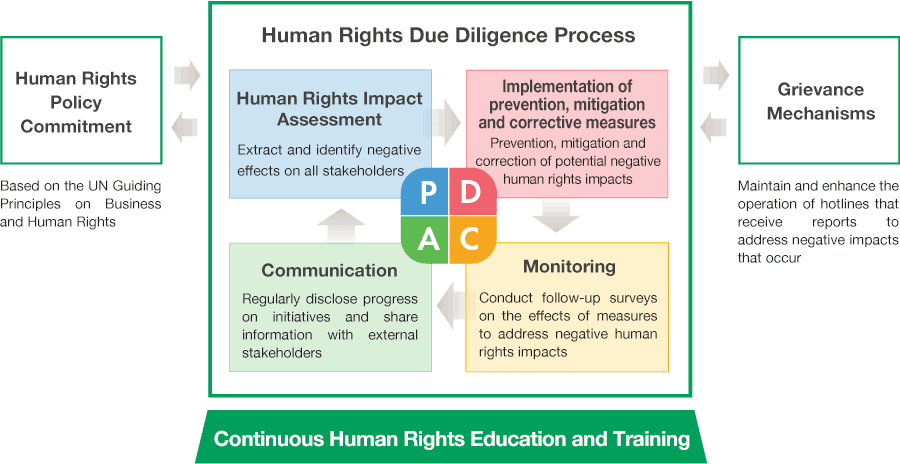
* Corporate measures to avoid causing human rights violations and provide remediation for the victims of such violations
The Group’s main business encompasses the development, manufacture and sale of household products. Among these, we notably handle many cleaning products, including laundry detergents. The surfactants that comprise the washing ingredients of these products are derived from such raw materials as palm oil, palm kernel oil and their derivatives. The main production areas for palm oil and palm kernel oil are Malaysia and Indonesia, and we recognize that these countries and areas as well as the commodities themselves bear relatively high human rights risks and pose problems regarding sustainable procurement, including human rights based on data provided by international human rights organizations and Sedex. Specifically, human rights risks such as overwork, the use of child labor and smoke damage from illegal slash-and-burn forest clearing are assumed for stakeholders who may be placed in vulnerable positions such as palm plantation workers.
In addition, corrugated boxes used to package and transport household products use a large amount of paper and pulp as packaging materials, which may pose environmental human rights risks due to inadequate forest management and other factors.
In our manufacturing processes, we rely on the cooperation of a wide array of raw material manufacturers and production contractors. If human rights risks arise from transactions with suppliers that are not fully committed to sustainable procurement practices—including respect for human rights—this could lead to disruptions in product supply as well as impact the reputation of the Group.
Furthermore, even within our own value chain—encompassing planning, procurement, research, production, sales and administration—risk factors such as overwork, excessive working hours, discrimination based on race or gender, and harassment may arise or be exacerbated among Lion employees, temporary employees and business partners. When expanding our business beyond product sales to include services, the increased points of contact with consumers necessitate even greater vigilance regarding privacy rights, including the management of personal information.*
* Refers to the International Trade Union Confederation (ITUC) Global Rights Index, etc.
In order to further clarify the potential and actual human rights risks that may occur in the value chain in the countries and areas where the Group operates, we have identified 25 human rights issues as relevant to the Group’s business activities based on the International Bill of Human Rights, the Ten Principles of the UN Global Compact, the ILO Declaration on Fundamental Principles and Rights at Work, the Children’s Rights and Business Principles and other international standards related to human rights.
In extrapolating human rights issues, we have referred to the social context surrounding business operations and human rights, the United Nations Environment Programme Finance Initiative (UNEP FI), guidelines on human rights formulated by the Japan Business Federation and advice from external experts.
| Forced and coerced labor | Freedom to form and join trade unions | Protection of motherhood and childhood | Just compensation and living wages | Right to privacy |
| Freedom of movement and residence | Equal pay for equal work | Harassment | Freedom of employment and unemployment insurance | Impacts on the lives of local residents |
| Child labor | Discrimination in hiring | Freedom of thought and religion | Right to safe and healthy working conditions | Access to water |
| Right to an education | Discrimination in the terms and conditions of employment | Overwork and excessive working hours | Right to a decent standard of living and health | Environmental management |
| Rights of young workers | Discrimination in opportunities and evaluations | Right to rest and leisure | Right to social security | Consumer safety and health |
On an annual basis, the Lion Group identifies human rights issues posing potential challenges to its business activities through the assessment of potential and actual historical impacts of said issues on our stakeholders: our employees and temporary employees; business partners, including contractors; suppliers; communities, including indigenous peoples; and consumers.
Based on the United Nations Guiding Principles Framework and other guidelines on human rights, we assess the scale of human rights violations, the scope of those violations, the likelihood of occurrence and the possibility of resolution. This task is undertaken mainly by persons responsible for the relevant departments as well as an investigative committee on human rights, who after making a comprehensive judgment based on such factors as changes in business and society and the opinions of stakeholders, including external experts, creates a risk map based on the results of the Human Rights Issue Check Sheet that identifies outstanding human rights issues as priorities for the Company.
For priority issues (salient human rights issues) identified by the human rights impact assessment, we implement the following actions to prevent, mitigate and remedy negative human rights impacts.
| Priority Issues for the Company (Salient human rights issues) | Measures and progress toward preventing, mitigating and correcting negative impacts | 2025 Results |
|---|---|---|
| Suppliers using forced labor or child labor, violating the rights of young workers, imposing overwork and excessive working hours, impinging the right to enjoy safe and healthy working conditions, freedom of residence and relocation, denying the right to education, freedom of work and employment security | We are promoting the procurement of third-party certified raw materials, such as RSPO and FSC certified products like palm oil, palm kernel oil, paper and pulp, in cases where human rights risks are of particular concern. |
|
| We are using self-checks based on the Lion Group Supplier CSR Guidelines and Sedex and implementing risk assessments at suppliers. |
|
|
| We add the Lion Human Rights Policy, the International Bill of Human Rights and the ILO Declaration on Fundamental Principles and Rights at Work to the memorandum of the Lion Group Supplier CSR Guidelines and are requiring that the human rights policy be endorsed and followed by suppliers as well. |
|
|
| Supplier’s local community access to clean water resources, impact on local livelihoods and environmental management | To prevent, mitigate and correct such negative impacts as lack of access to water resources in local residential communities near supplier bases, self-checks based on the Lion Group CSR Guidelines are including questions regarding environmental management to ascertain the status of specific initiatives undertaken for the community. |
|
| Overwork, excessive working hours and internal employee harassment among our business partners | To prevent, mitigate and correct the causes, contributing factors and the negative effects themselves of overwork and excessive working hours at our business partners, we are working to disseminate and establish the Lion Group Charter of Corporate Behavior and the Lion Human Rights Policy through e-learning and training programs for our employees. In addition, we are quantitatively assessing our employees’ understanding of these issues and evaluate their behavior at work through the Compliance Awareness Survey. |
|
| Consumers’ right to privacy | To prevent and reduce the risk of personal information leaks and thereby protect consumers’ right to privacy, we have established policies and regulations such as the Personal Information Management Regulations, the Basic Policy of Our Information Management, the Information Management Regulations and the Information Security Regulations in accordance with the Act on the Protection of Personal Information. We also implement annual e-learning programs on information security and information management systems as part of Company employee education, and continually strengthen information security measures, including personal information protection at overseas affiliated companies, in accordance with laws and regulations. |
|
The Group has established the AL (All Lion) Heart Hotline, an internal and external whistle-blowing system, as a grievance mechanism to manage complaints about transgressions of business ethics, particularly those involving human rights.
Under this system, whistleblowers can be stakeholders from outside the Group, like business partners. The privacy of whistleblowers and reported parties informants is safeguarded and secrecy is assured for any investigations. Aside from anonymous reports, etc., all instances are also relayed to all whistleblowers.
In 2025, the AL (All Lion) Heart Hotline fielded reports regarding various human rights issues, including harassment; however, no cases were deemed to involve serious case , and all were handled appropriately.
For details of the system and the details of consultation and reporting, please refer to the following link on the Company’s website.
Internal and External Whistle-Blowing System (AL Heart Hotline)Each preventive, mitigating and corrective measure is assigned a qualitative or quantitative indicator and monitored twice a year by the investigative committee on human rights.
The status of human rights initiatives, etc. is published on the Company’s website as necessary.
Lion implements annual e-learning training for all domestic employees (including part-time employees) to ensure that the Lion Group Charter of Corporate Behavior and the Lion Human Rights Policy are widely understood and firmly established.
In addition, every year we conduct a Compliance Awareness Survey for all domestic employees (including part-time employees) to quantitatively and qualitatively assess their awareness of compliance, including with regard to human rights and workplace behavior, while providing feedback to each department on the results to raise employee awareness and create a better environment.
In promoting human rights due diligence, we held study sessions and exchanged opinions on business and human rights with directors, Audit & Supervisory Board members, executive officers, managers of divisions with human rights jurisdiction and external experts to deepen understanding of the issues.
The Group also participates in such external initiatives as workshops held by the Human Rights Due Diligence (HRDD) Subcommittee of the Global Compact Network Japan (GCNJ) and in working groups of the Supply Chain Subcommittee to promote understanding and awareness of social conditions surrounding human rights. The Japan Cosmetic Industry Association (JCIA), to which we belong, has formulated Sustainability Guidelines as well as the Guide to Human Rights and Labor Risk Responses in the Value Chain.
Going forward, we will continue to actively work toward the realization of the sustainable development of society, including human rights.
We regularly conduct hearings with each of our overseas Group companies on issues regarding human rights that are assumed to be incorporated into their business activities. During those hearings the Company uses the Sustainability Activities Conformation Sheet, which with the help of external experts, identifies the issues that need to be considered in the countries and areas where we operate with respect to key sustainability issues as a means of ascertaining the status of prevention, mitigation and corrective measures and responses, as well as monitoring the progress of such measures and responses.
For suppliers that conduct business with our overseas Group companies, we use self-checks based on the Lion Group Supplier CSR Guidelines and Sedex’s data analysis to assess the impact of suppliers on matters related to the Group’s Procurement Policy, including human rights and labor.