Close
Close
The Lion Group is working to reduce CO2 emissions throughout product lifecycles in line with LION Eco Challenge 2050, a set of long-term environmental objectives formulated in 2019 with the goal of realizing environmental sustainability.
Since 2013, Lion has been calculating CO2 emissions across its entire supply chain, tracking emissions throughout product lifecycles—from raw material procurement to production, transport, use and disposal. Total CO2 emissions throughout the lifecycles of Lion’s products in 2025 was approximately 3,789 thousand metric tons.
Breakdown of CO2 emissions over the lifecycles of Lion Products*
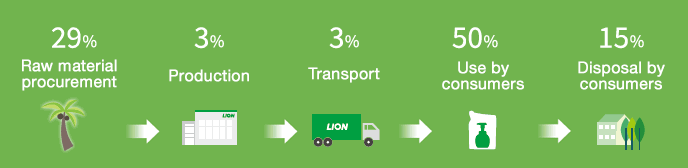
* Scope: Lion and consolidated domestic and overseas Group companies, January – December 2025
At 50% the point in the product lifecycle that accounts for the largest portion of CO2 emissions is the consumption stage. This is because many of our products are used in conjunction with hot water, which itself is produced using CO2 emissions generating energy sources like electricity, gas or kerosene. Moreover, simply securing a water supply (intake, purification and pumping) consumes electricity as does post consumption wastewater treatment.
The Lion Group will continue to work with consumers to reduce CO2 emissions throughout product lifecycles by providing environmentally friendly products and services that help save water and promoting the formation of environmentally friendly habits.
Reducing Water UseLion works to reduce CO2 emissions and energy consumption intensity through the following efforts.
Lion’s overall modal shift rate in 2025 increased year on year. The modal shift rate for intra-company transport was 9.6% (compared with 9.2% in 2024). Annual CO2 emissions from logistics came to 17,046 tons, down 10.2% year on year. Energy consumption intensity decreased 9.3% compared with the previous year, for a five-year average annual decrease of 5.3%, achieving Lion’s target of an average annual reduction of 1% or more. We will continue efforts in these areas going forward.
The Eco Rail Mark system was created by the Ministry of Land, Infrastructure and Transport to certify companies and products that use rail freight transport for a certain portion of product shipment. Because distribution processes are typically opaque to consumers, the Eco Rail Mark is a useful means for companies to indicate that they use or their products are shipped using environmentally friendly rail freight transport.
Lion’s Eco Rail Mark certification was renewed in 2025. The certified Lion products are listed in the Eco Rail Mark pamphlet published by the Railway Freight Association and introduced on the website of the Ministry of Land, Infrastructure, Transport and Tourism.

The following four products are certified (as of June 2026).
Addressing such social issues as the logistics “2024 problem” and the need for sustainability, we established a multi-shipper mixed transport model employing shipping trailers using standardized transport modules. More efficient than the previous system, in which individual companies handled cargo transport independently, in this model, multiple companies coordinate schedules and cargo volumes so that shipments cannot only be consolidated but round-trip transportation using multiple shippers across industries is possible.
The overall effect of this initiative was a reduction of 31.2 tons of CO₂ per year (19.0% reduction), a reduction of 250 hours per year (15.4% reduction) in the number of driver hours, and a reduction of 39 vehicles per year (28.9% reduction).
As a result of these pioneering efforts, Lion and the other companies jointly received their third consecutive commendation, being recognized with the top MLIT Minister’s Award for Green Logistics Partnership in the FY2024 Excellent Logistics Partnership Commendation Program.
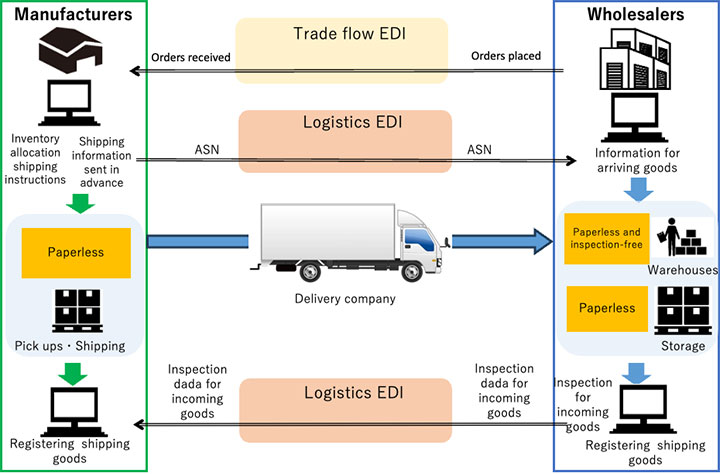
The logistics “2024 problem,” necessitated the logistics efficiency of the entire household consumer product industry to be improved, particularly because there are limits to what can be achieved through individual company efforts. With the aim of achieving paperless, inspection-free, and efficient warehousing and shipping operations, we implemented advance shipping information (ASN). In doing so, we took on a leading role in the industry as a whole by proposing concepts and refining implementation models through participation in demonstration experiments within the Working Group for Standardization of Household Consumer Product Logistics. Thanks to the prior introduction of ASN transmission and shipping receipt-less systems and the strengthening of cooperation with a major wholesaler, we were able to reduce outbound clerical work by 30% and inbound field work by 50%, resulting in an industry-leading model for supply chain optimization in the industry as a whole, particularly from the perspective of improving the labor environment and the SDGs. For this reason, Lion received the top prize at the Supply Chain Innovation Awards 2024, sponsored by the Ministry of Economy, Trade and Industry (METI) and the Manufacturing, Distribution, and Sales Cooperation Council.
* Electronic Data Interchange.