Close
Close
Providing indispensable functions that facilitate many daily tasks, chemical substances are essential to assuring comfortable and fulfilling lives. Failure to properly manage chemical substances, however, can result in accidents that put human health and ecosystems at enormous risk. In addition to compliance with related laws and regulations, the Lion Group strives to ensure the strict management of chemical substances at all stages from product development to use and disposal in accordance with its own independent standards.
Based on the spirit of the Lion Group Charter for Corporate Behavior, the Group has established the Chemical Substance Management Policy. This policy was formulated in light of international trends in chemical substance management and is aligned with the Global Framework on Chemicals*1 (GFC) and the Strategic Approach to International Chemicals Management*2 (SAICM). The policy stipulates that we will strive to implement sound management of chemical substances throughout their lifecycles, minimize significant adverse impacts on the environment and human health, and promote communication. A relatively new international framework, the GFC was adopted in 2023 with the aim of realizing a world free from the harmful effects of chemicals and waste and strengthening international chemical management. Covering the entire lifecycle of chemicals, it sets forth five strategic objectives and 28 targets to protect the environment and human health. A key feature of the GFC is that it promotes sustainable chemical management through collaboration among diverse stakeholders, including national governments, industry, and civil society.
*1 Adopted in 2023 as the successor to SAICM
*2 Adopted from 2006-2020
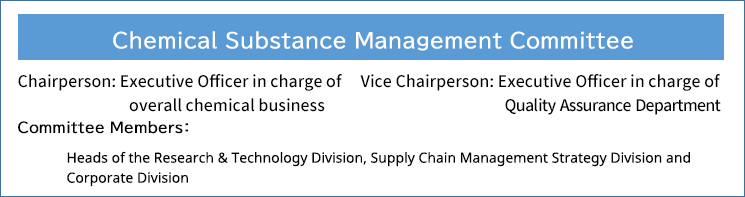
In 2023, we established a Chemical Substance Management Committee, chaired by the executive officer in charge and vice-chaired by the executive officer in charge t, and composed of members from the Research, Production and Logistics, Overseas Business, and Head Office Staff departments. This committee promotes activities in line with the Group’s Chemical Substance Management Policy.
We strictly manage chemical substances at every stage of the process, from product development and production to transportation, use and disposal.
Group-Wide Management of Chemical Substances
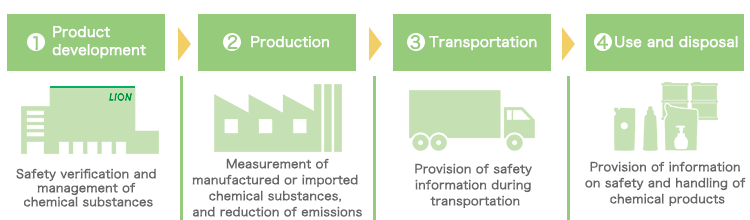
The types and amounts of chemical substances used in products are determined at the product development stage, with consideration given not only to enhancing product performance, but safety and environmental impact.
Based on the Act on the Evaluation of Chemical Substances and Regulation of Their Manufacture, etc., Lion notifies the relevant authorities of the use classifications and volumes of all the general chemical substances and priority assessment chemical substances it manufactures or imports (with exceptions based on the provisions of the Act, such as for substances manufactured or imported in quantities of less than one ton per year). We will continue to gather information about the volumes and uses of manufactured or imported chemical substances and file proper notifications.
Lion Corporation Korea pre-registers and registers chemical substances under K-REACH.*
*
K-REACH
The common name for South Korea’s Act on the Registration and Evaluation of Chemicals
Going forward, with expectations of ongoing growth in calls for the proper management and stricter regulation of chemical substances, Lion aims to continue stepping up the filing of proper notifications and management of emissions volumes as required under the Act on the Evaluation of Chemical Substances and Regulation of Their Manufacture, etc.; regulations on volatile organic compounds (VOCs); and the Water Pollution Prevention Act, as well as to ensure safety during manufacturing in accordance with the Industrial Safety and Health Act.
The PRTR (Pollutant Release and Transfer Register) system is a scheme for collecting, compiling, and publishing data on the degree to which a wide variety of potentially harmful chemical substances are released into the environment from what sources, or are transported off of production sites through waste disposal.
The Company’s annual emissions of PRTR-designated substances have remained at 2 to 9 tons since 2020.
Lion implements initiatives to reduce emissions of chemical substances that cause air pollution, including nitrogen oxides (NOX), sulfur oxides (SOX), particulate matter and VOCs. The Air Pollution Control Law designates emissions standards by type of substance and by type and scale of emitting facility, and many regional governmental bodies have established additional regulations by ordinance. In addition to complying with such laws and ordinances, each plant has formed strict agreements with local municipalities and established strict voluntary standards, in accordance with which we strive to prevent pollution. Furthermore, we are working to reduce emissions by such means as improving the efficiency of production processes and utilizing environmentally friendly equipment, such as nitrogen and sulfur scrubbers.
A maximum limit on COD*1 of 160mg/L (and a daily average of 120 mg/L) has been set by law as a nationally uniform standard within environmental standards related to water pollution per the Water Pollution Prevention Act and Sewerage Act. Lion also meticulously complies with these regulations when discharging wastewater into public sewer systems. Furthermore, Lion aims for even stricter wastewater quality management, and some of our operating sites have formed agreements with local governments to maintain a COD limit stricter than the uniform standard. To comply with these agreements and achieve even higher standards of wastewater management we strive to stabilize operations at each wastewater treatment facility while performing regular maintenance and continually improving treatment methods.
*1
COD
Chemical oxygen demand. An indicator of water contamination. Indicates the amount of oxygen that will be consumed in the oxidization and decomposition of the organic matter content of the water.
Lion’s suppliers provide safety data sheets (SDSs)*2 on all the raw materials it uses. To ensure the efficient and effective use of SDSs, they are listed in a database. Lion Hygiene Co., Ltd., which supplies products to businesses, also prepares and distributes SDSs to its business partners to help on-site workers perform their tasks more safely, and labels its products in accordance with the GHS.*3
*2
SDS
Prepared with the aim of preventing accidents caused by chemical substances, these documents provide information about the environmental impact of, safety precautions regarding and the appropriate handling of chemical products.
*3
GHS
An abbreviation for the Globally Harmonized System of Classification and Labelling of Chemicals. A labeling system based on globally standardized rules adopted by the United Nations for classifying the hazards and toxicity of chemical substances.
In accordance with the Lion Group Chemical Substance Management Policy, and with the aim of ensuring workplace safety, Lion utilizes an SDS database to manage the raw materials and products handled within its facilities. Through this, we strive to ensure consistent GHS labeling at all operating sites, conduct training on the safe handling of chemical substances, and promote the proper use of personal protective equipment.
In case of an accident during the transportation of raw materials or intermediate products, Lion provides information to carriers about emergency response by distributing and attaching yellow cards and container yellow cards* to shipments.
*
Yellow cards and container yellow cards
Yellow-colored emergency contact cards providing information about the properties of and emergency response methods regarding chemical substances in case of leaks of other issues during transportation. Yellow cards are for carriers to keep with them during transportation, while container yellow cards are attached to the containers in which chemical substances are stored. Both are prepared based on voluntary industry standards determined by chemical companies.
After use, residual surfactants from detergents and other products may be discharged into the environment. Twice a year, Lion takes part in the Japan Soap and Detergent Association’s environmental monitoring and risk assessment of four types of surfactants in rivers near Tokyo and Osaka in order to ensure that the impact of these substances on local ecosystems is minimal.
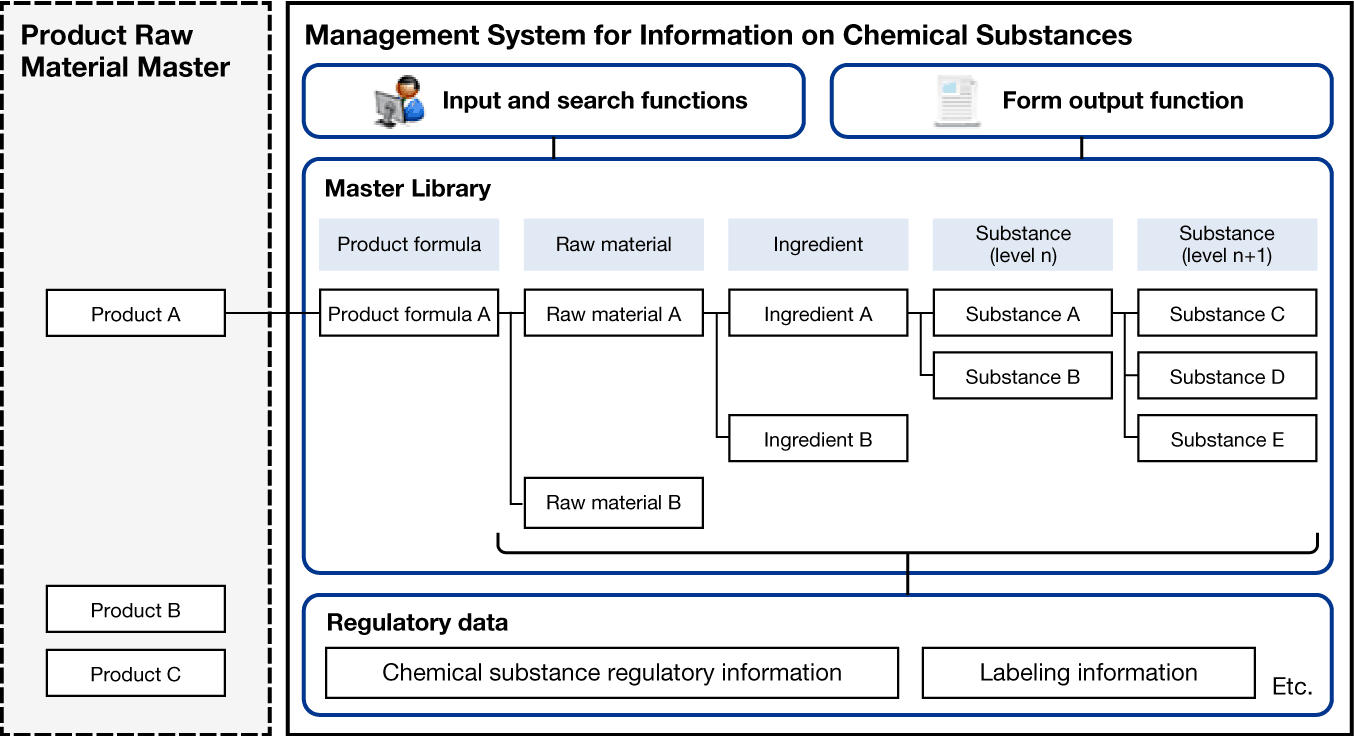
Since January 2018, Lion has been rolling out a Management System for Information on Chemical Substances at its purchasing departments and research and development sites, including those of domestic affiliated companies, to reinforce the proper use of chemical substances. We use this system for the management of raw materials and the chemical substances contained in products.
The system comprises a database of raw materials and product formulation data, a database of regulatory data, and product formula development support functions. The adoption of the system has reinforced our framework for ensuring legal compliance regarding chemical substances used in products during product development across all our business fields. In addition, the system’s accumulated data allows employees to instantly search for the chemical substances contained in products that have been released. This has helped enhance data management, secure traceability and reinforce our ability to ensure compliance.
In 2021, the use of nonylphenol ethoxylates (NPEs) in the EU was restricted by EU REACH.* Furthermore, in April 2025, NPEs were designated as Class II Specified Chemical Substances under Japan’s Act on the Evaluation of Chemical Substances and Regulation of Their Manufacture, etc. in 2024. Lion has already discontinued the use of NPEs and completed the process of replacing them with substances that have a lower environmental impact.
*
REACH
Registration, Evaluation, Authorisation and Restriction of Chemicals
Lion participates in the Japan Chemical Industry Association and has constantly improved the environmental performance and safety of chemical substances throughout their life cycles, from development through disposal.
Since 2011, Lion has invested in and endorsed the objectives of the Long-Range Research Initiative (LRI), a project implemented through the Japan Chemical Industry Association (JCIA), which provides grants for research on the safety of chemical substances and methods for their evaluation.
As a member company of the Japan Chemical Industry Association RC Committee, Lion proactively engages in dialogue with local communities. Each plant provides opportunities for dialogue suited to the characteristics of its local community to promote communication with community members.
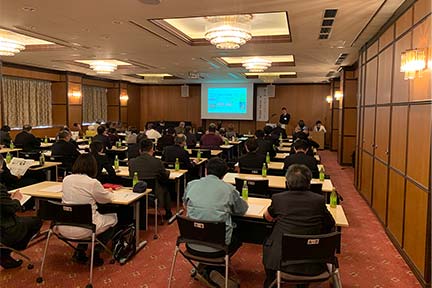
The 15th Responsible Care Chiba Regional Dialogue was held in January 2025, the first time in six years the event was held in-person, and saw the participation of neighborhood associations, neighborhood association councils and government officials. Our Chiba Plant participated and cooperated in the meeting from the planning stage. Booklets were distributed with information regarding SGDs supplied by companies in the Chiba area. We distributed a booklet containing presentation materials from the meeting and a two-dimensional barcode that allows users access to information on the activities of member companies and a member survey. We plan to take the survey’s findings into consideration in our future activities.
In addition, the 14th Responsible Care Sakai/Semboku Regional Dialogue was held in February 2024—the first in-person discussions in four years, with neighborhood associations, neighborhood association councils, and government officials participating. On the day of the event, our environmental manager reported on the environmental initiatives of Lion and Osaka Plant. In addition, the opinions of event participants were collected through a survey and will be reflected in our future efforts to continuously improve our environmental initiatives.
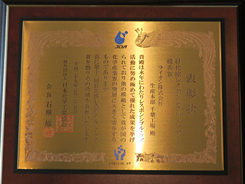
Moreover, in May 2017, the Chiba Plant received its 11th Responsible Care Award from the Japan Chemical Industry Association (JCIA) for its initiatives to protect the aquatic environment and contribute to the local community.
JCIA Responsible care refers to voluntary management activities performed by companies that handle chemical substances, encompassing the assurance of protections for the environment, safety and health throughout all processes of chemical substance development, manufacturing, distribution, use, final consumption, disposal and recycling as well as the disclosure of the results of such activities and dialogue with society.
Since the start of its operations, the Chiba Plant has continuously implemented activities to protect the local aquatic environment from water-related risks. The plant’s efforts to purify industrial water for various applications, recycle wastewater used in industrial processes and manage wastewater according to standards stricter than those required by law have led to reductions in water usage and discharge volumes and the conservation of water quality. The award also commended the plant for providing education about the importance of water through initiatives with local children and plant tours.